


Powered by artificial intelligence, personalized by you
Save time, work smarter, and focus on what truly matters: building meaningful donor relationships. GC Intelligence, the AI power behind the GiveCampus platform, makes it easy to generate content, predict donor behavior, and chat your way to the answers you need in an instant.
Meet GC Intelligence
Now you can generate first drafts in seconds, predict who to engage with when, and use chat for answers to everything but where you left your car keys.

GENERATE
Spend less time wordsmithing and more time fundraising
Skip the blinking-cursor-on-the-blank-page part of your day and go directly to a solid first draft. Starting with a simple click, GC Intelligence leverages generative AI to create targeted outreach, detailed contact reports, personalized follow-up emails, comprehensive donor bios, and more—all in a matter of seconds.
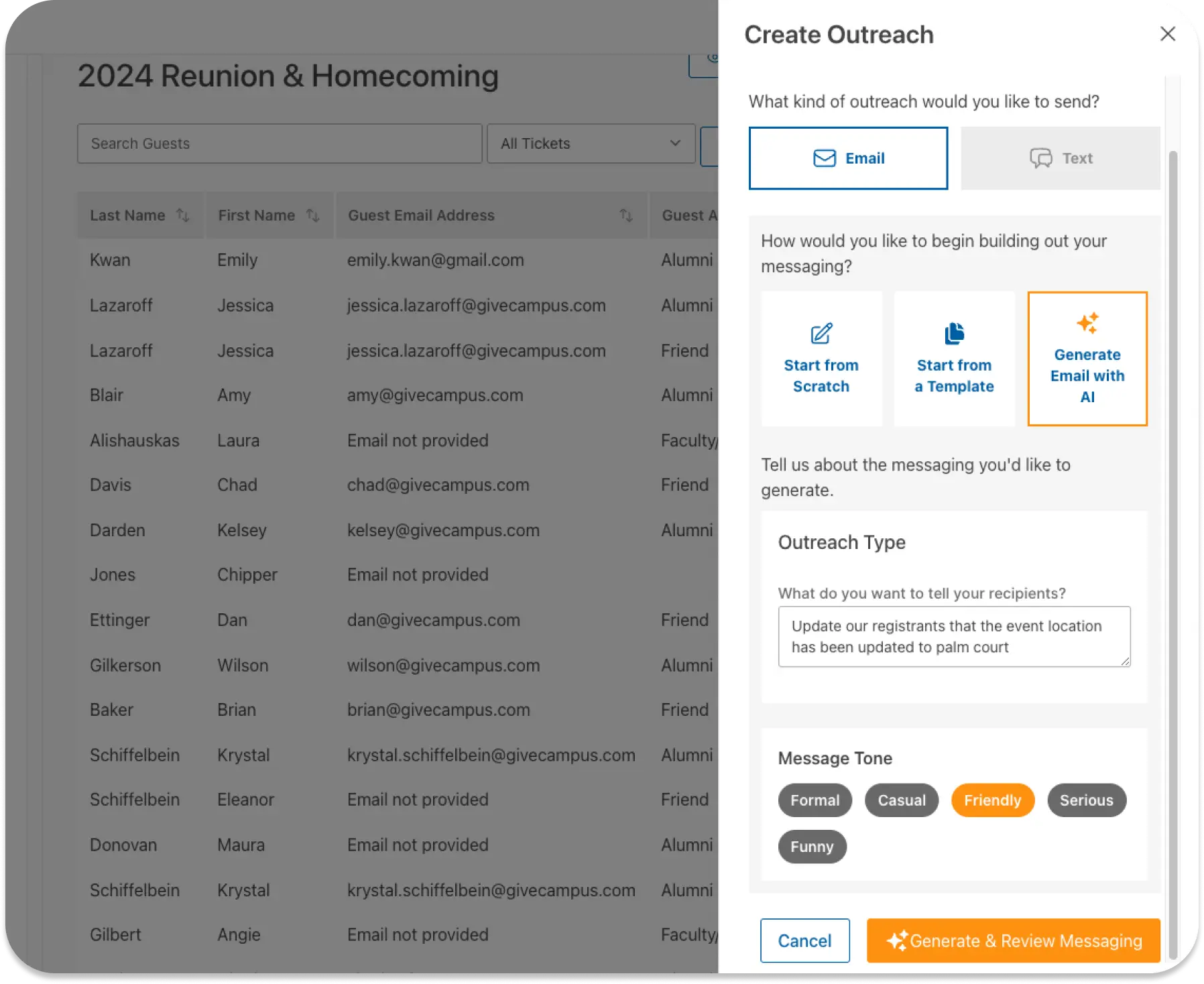
Spin up targeted giving day emails and reunion invites in a flash
GC Intelligence is the first and only generative AI trained to think like a seasoned fundraiser, so it not only knows what a LYBUNT is, it knows how to message them in a way that resonates. With smart, custom-built prompts at your fingertips you can instantly draft targeted emails, invites, and more using campaign and event data ALREADY in GiveCampu
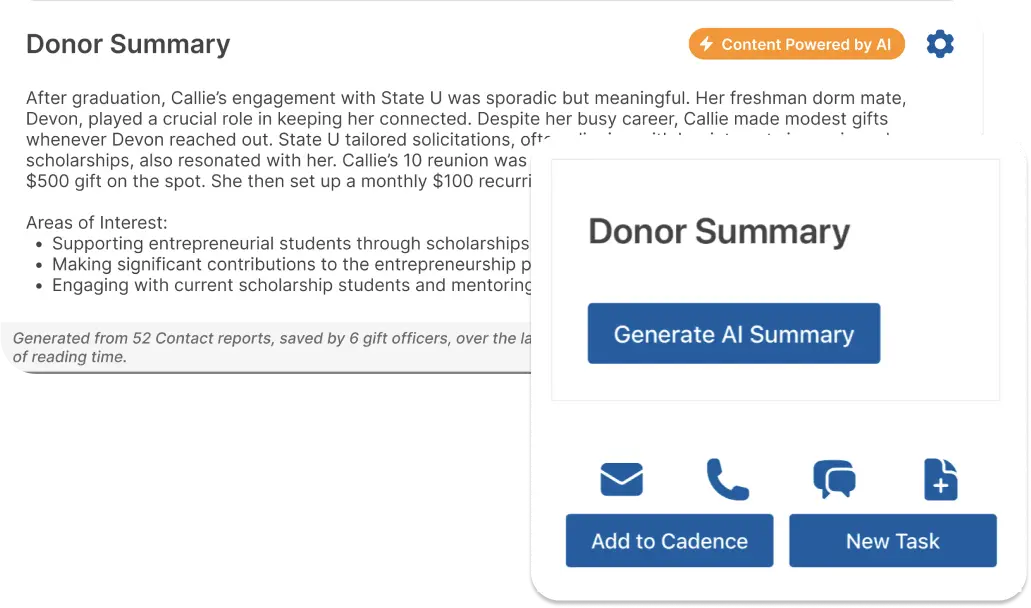
Shave hours of administrative time off every work week, and days off every month
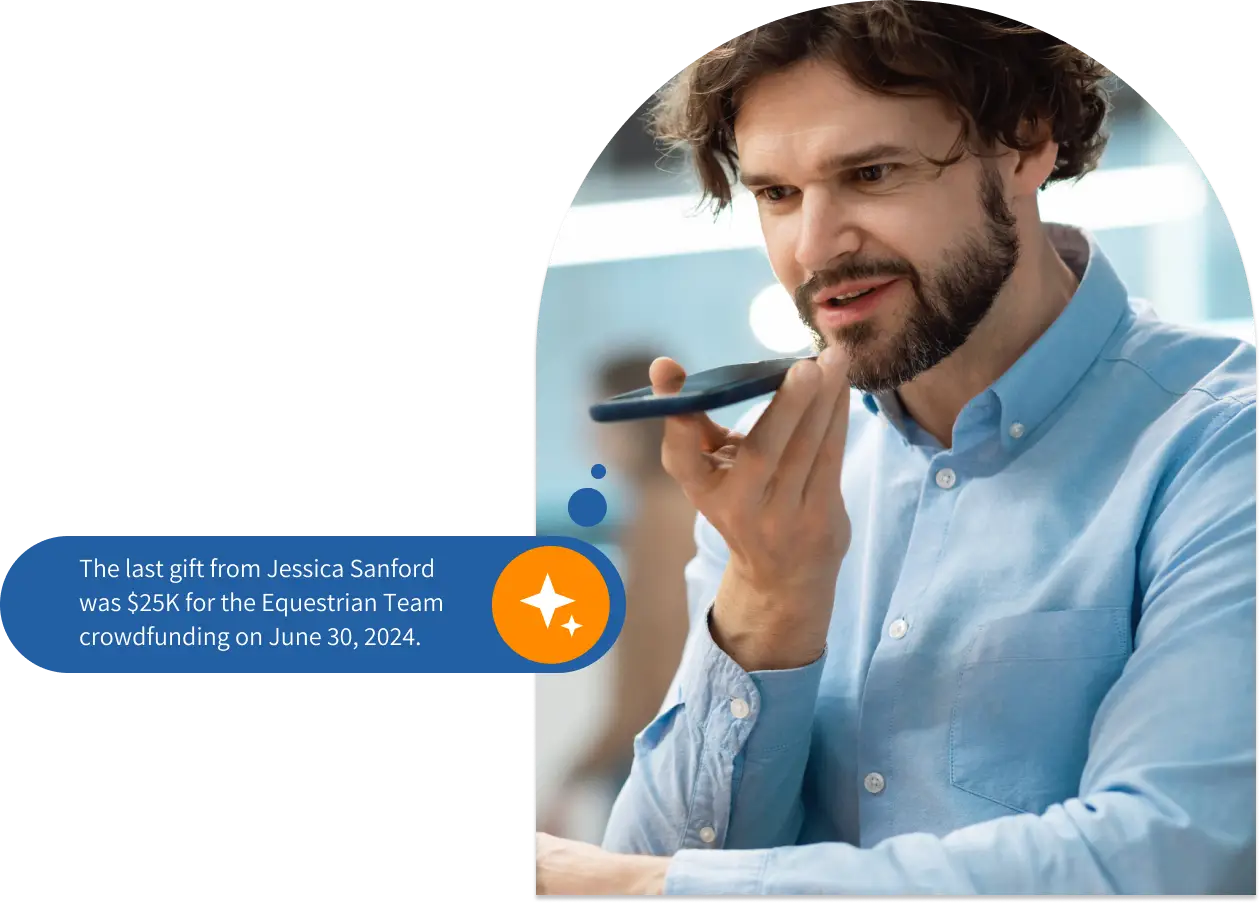
GC Intelligence instantly transforms voice or text notes into a contact report template, tasks, a follow-up email, and more. Need quick intel ahead of an in-person visit? GC Intelligence can generate a comprehensive donor summary, including prior interactions, all on the fly.
PREDICT
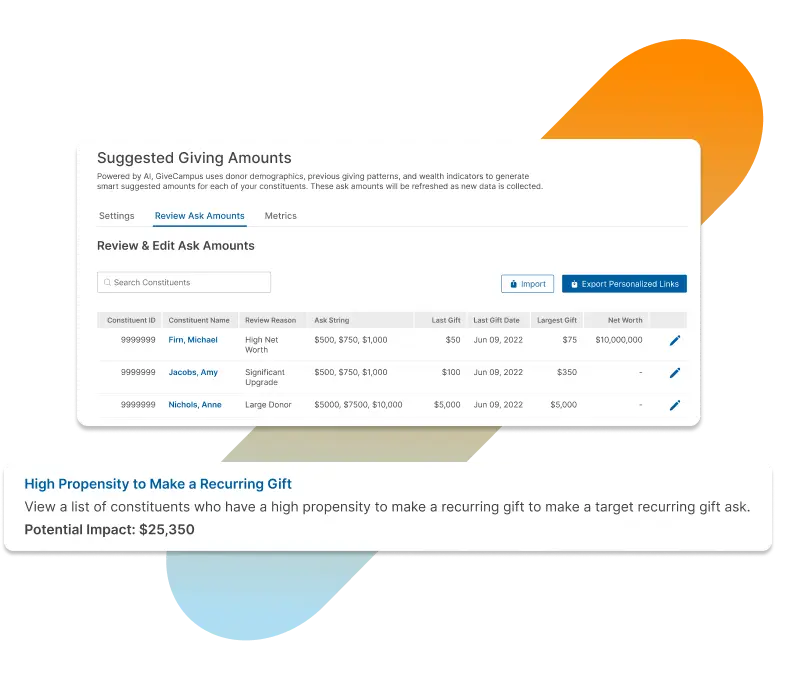
Solicit smarter by making the right ask to the right individual at the right time
Drive more dollars, donors, volunteers, and overall conversions with a little help from AI. GC Intelligence leverages machine learning to predict which constituents are most likely to say yes to your ask. It even recommends ask amounts and suggests the best moment to reach out.
Chat
Stop clicking around for answers—and just ask GC GO
Meet the know-it-all personal assistant you never knew you needed (and now can’t live without). Get answers, recommendations, reminders, and more. GC Intelligence lets you chat your way through daily tasks.
Katie Blum
Assistant Vice President for Strategic Innovation at University of Illinois Foundation
Katherine Malchoff
Director of Annual Giving at Westminster School
Matthew Lambert
Senior Vice President for University Advancement at William & Mary
GC INTELLIGENCE
Frequently Asked Questions
Predictive modeling in GC Intelligence helps GiveCampus make smart recommendations for key workflows throughout your use of the platform, such as the dollar amount to recommend to a constituent on a giving form, or which constituents to engage for a particular type of ask. Below you’ll find answers to frequently asked questions about how GiveCampus leverages artificial intelligence to drive better outcomes.

How is my data being used?
- 1 Your data is not being sent to any third party. Our predictive modeling is all done in-house.
- Our models only see anonymized data, not personally identifiable information (PII).
- Your data is never exposed to any other partner.
Who are your third-party vendors for Machine Learning?
We do not use any third-party vendor(s) and all our work is conducted in-house. We do leverage open-source code libraries to implement well-known algorithms, such as Neural Networks, Gradient-Boosted Decision Trees, Random Forests, and Support Vector Machines.
Is my data mixed with other customer’s data or used to train any models?
With respect to our Predictive Modeling service: our ability to build an accurate predictive model is predicated on training the model against a vast amount of anonymized data from over one thousand colleges, universities, and independent schools. However, one Partner’s (customer’s) data is never exposed to another Partner (customer).
How do you evaluate the effectiveness of your models?
With respect to our Predictive Modeling service, we gauge effectiveness based on real-world results (e.g., did the model reliably predict the desired outcome) and metrics. For example, for classification models used for GC Smart Segments, we use the following:
- AUROC (Area Under the Receiver Operating Characteristics Curve):AUROC (or AUC) is one of the most commonly-used measures of performance for machine learning classifiers. AUROC is derived from the ROC curve, which plots how well a model can strike a balance between maximizing true positives and minimizing false positives. It is represented as a percentage from 0-100%, where 50% is the expected performance of a “random” model.
- Precision: Of the constituents that the model predicted to be in the positive class (e.g., likely to convert), what percentage were actually observed to be in the positive class (converted)?
- Recall:Of the constituents that were observed in the positive class (e.g., converted), what percent did the model predict to be in the positive class (e.g., likely to convert)?
MEET EVAN, AI AGENT FOR HIRE
Need an icebreaker? Evan’s got your back
Make every in-person moment with high-value guests more personal and more productive with AI-generated mini bios and conversation starters, courtesy of Events Evan. Curious?
Blog
Navigating 2025 Advancement Trends: AI-Assisted, Human Led
Artificial intelligence is reshaping advancement work. Explore three key ways AI is making a measurable difference for advancement teams, while still keeping humans as an integral part of the work.
blog
The Philanthropy Forecast
What if you only solicited donors who were most likely to say yes? Read how GiveCampus is using AI to help fundraisers better understand constituents.

